Sunday, April 1, 2012

Something Sweet

Happy first day of April, everyone!!

Yesterday was my birthday (Whew, missed April Fools by "this much") and every beverage my friends got me was some kind of "cake" or pie flavor. Thanks to you, friends. :)

Cake got me thinking about the whimsical, delicious art of Wayne Thiebaud. In undergrad, I wrote a paper comparing Thiebaud's Around the Cake to Jean-Simone Chardin's La Brioche. To quote from my paper (in describing Around the Cake):

"He seemed in places to literally coat the paint on the canvas as if he were icing a real cake, giving the illusion of thickness and real frosting. The technique intrigues the viewer, tempting them to investigate whether or not the icing texture is real."

And then this morning, I found this wonderful video about a retrospective of Thiebaud's work, where you get to meet the adorable Thiebaud and learn a little bit more of his story. Enjoy!


"If we don't have a sense of humor, we lack a sense of perspective." - Wayne Thiebaud

Friday, March 23, 2012

Art Obsessions

I thought I'd use this opportunity to highlight a few of the (ART) things I am REALLY stoked about right now.

Cave to Canvas.

An online Art Historian/friend of mine runs another incredible Art History blog called Cave to Canvas. I highly recommend you check it out. She produces such a varied collection of art works/artists...there's something for everyone, and I think you'll discover new art interests you never knew you had! Her blog is great exposure to the art world....Go visit!


Franz Marc & German Expressionism.


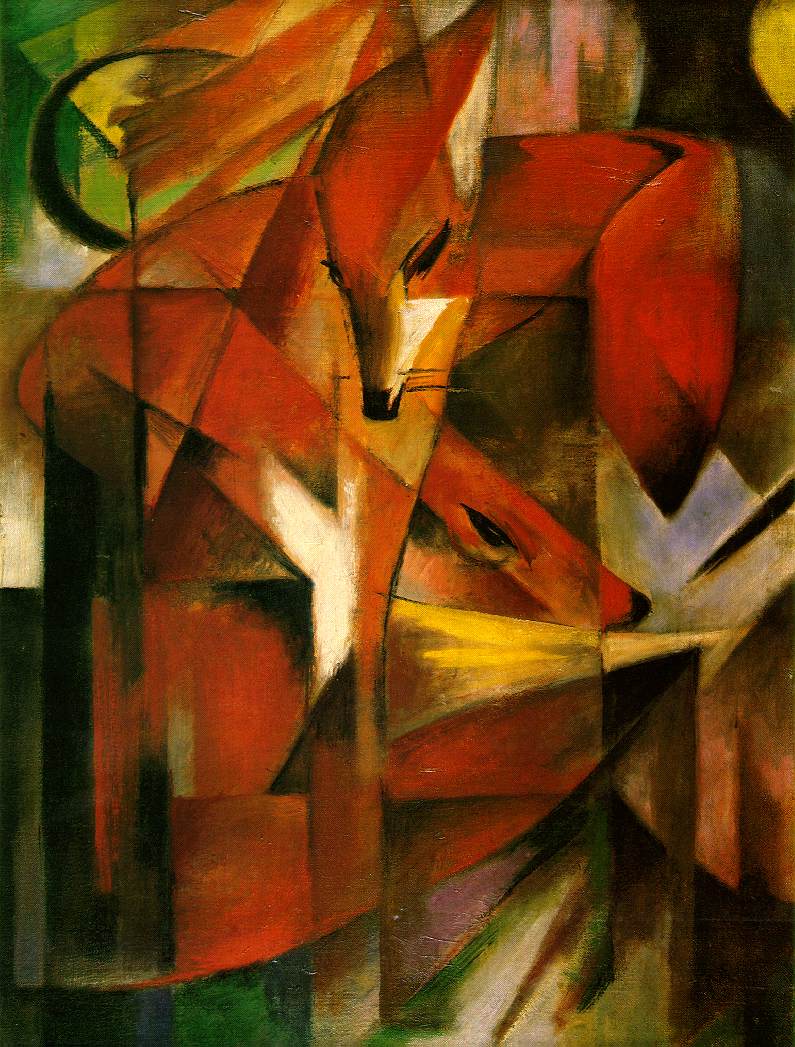
I have the fantastic opportunity to participate in a friend's thesis vocal performance for her Master's by providing a powerpoint of images from the period/artistic movement her performance relates to. It allows me to reiterate my love-love-love for German Expressionist Franz Marc and his colorful, dynamic, segmented animal paintings/drawings. Here at the museum, we have a watercolor sketch of four foxes by him that I fell in love with immediately. These Foxes (1913) at right are not that image, but it gives you the idea. :)

Foxes, 1913, Oil on canvas, 87 x 65 cm, Kunstmuseum, Dusseldorf. Via.


Fine Art in High Fashion.


When googling 'art in fashion,' this was one of the incredible pieces I found. Dior, in their exhibit Inspiration Dior at the Pushkin Museum in Moscow in 2011, amassed an unbelievable fashion collection for display. If you follow the link, you can even view the exhibition itself in 360 degrees like you're there. The piece that blew me away, made known from Wicked-Halo.com was this...Dior's tribute to Japanese print-maker Hokusai's ultra-famous The Great Wave off Kanagawa, 1829-32. The collection looks at other 19th-century art works as fashion inspiration as well, including works from Gauguin, Matisse, Picasso and others.

Monday, March 19, 2012

"Letting it magically happen" - The art of Sylvia Ji

Wow.

I started tonight with the intention of gathering quotes by female artists to share with you all in honor of Women's History Month (March). Instead, I happened upon a new, contemporary artist I had never seen before, and I have to say, I'm pretty enthralled.

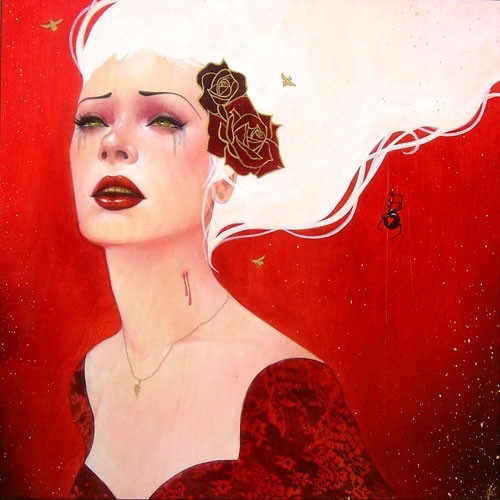
Red Quechquemitls, 2010. Via.

This was the first work of Sylvia's that I saw, and truth be told, the elaborate face painting reminded me of a calavera from the Mexican Día de los Muertos, and I assumed (wrongfully) that this was going to be a latin artist. At least I was right in believing this traditional Mexican holiday inspired her.

I still remember learning about el Día de los Muertos (November 2nd) for the first time in the 8th grade from my exceptional, and slightly eccentric, social studies teacher Mrs. Lynch. She was so cool. And el Día is a fantastic, slightly spooky, holiday too. It's like Halloween, in a way, but is specifically for honoring one's deceased ancestors, vs. gorging oneself on as much candy as humanly possible.

Blue Rose, 2008. Via.

Sylvia Ji was born in 1982 and received her BFA in Illustration from the Academy of Art in San Francisco. She's exhibited her work worldwide, presenting in both group and solo shows, her first successful solo show happening in the last year of her undergraduate career.

Belle Epoch, 2005-2006. Via.

Ji's style and content are both beautiful and edgy, whimsical and haunting, provocative and emotional. The graceful women she depicts express a range of emotion: daring, sadness, longing, a challenge, lust, anger, and almost all evoke a sense of mystery. According to the Joshua Liner Gallery (New York, NY), Ji's women can be symbolic reflections of herself, people she knows, or "nameless faces set in a landscape of fleeing and decaying beauty."

Black Domina, 2008. Via.

She embraces a range of cultures in her works, all the while focusing on women. The Mexican flavor is obvious. She also has some Asian women, what appear to be Native American women, Baroque European, and more French looking women throughout in oeuvre. (Is calling it an oeuvre too art historical of me?)

Lovesick, 2005-2006. Via.

Lovestruck, 2005-2006. Via.

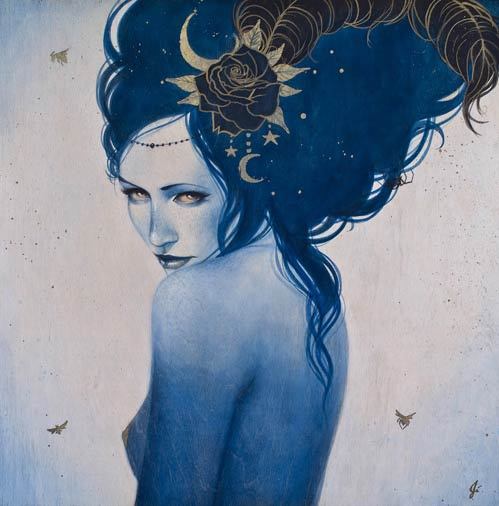
I was personally drawn to these works because of a) the calavera painted faces; b) the intense colors; c) the feminine mystique and mystery, as well as raw emotion of her characters; d) the elaborate costuming. Even on Nyx, seen below, who is for all-intensive purposes wearing nothing, the rose, feather plume, crescent moons, and stars in her unruly, piled-high mane is just exquisite. Lovestruck and Lovesick above remind me a little bit of Alice in Wonderland.

Nyx, 2009. Via.

Calendula, 2011. Via.

This one is probably my favorite. I love the contrast between the yellow-oranges and the green-blues for starters. Next, while her gaze is absolutely haunting and penetrates every nook and cranny of your soul....her gaze penetrates every nook and cranny of you soul. It's a full-frontal conversation between Calendula and the viewer. And obviously not a very good one. Her unyielding, narrowed sky-colored eyes leave you wondering..."what in the heck did I do to offend this chick?" It makes the viewer fathom and imagine a story in their heads...and that is a very powerful thing.

I guess that's just it. For me, her work is Power.

Thursday, February 23, 2012

Pounamu Tāonga...The Maori Hei Tiki.

Am I on a roll lately, or what? February is making up for my lack of posting in January, that's for sure.

At work, we were planning an ad for a local magazine, and were trying to find pieces in the museum's collection to emphasize. One of my favorite options was this one, a Hei Tiki pendant from New Zealand, created by the Maori peoples. It is the most brilliant green (I'd describe it as a cloudy emerald color), and its eyes are made of haliotis (abalone) shell, which really shines. In New Zealand, this shell is called a paūa shell.


Oceania
Maori peoples, New Zealand
Pendant,
Hei Tiki
Nineteenth century
Nephrite, haliotis shell
H. 9 in. (22.9 cm)
Raymond and Laura Wielgus Collection,
Indiana University Art Museum

I traveled to New Zealand as a People to People Student Ambassador when I was 13. The trip left an indelible mark on me, and spending time with the Maori was one of the incredible experiences. If you are a parent reading this blog, I must absolutely recommend to you that you allow your child the opportunity to participate in one of these international leadership adventures. It helped me grow as a person and become more aware of the world, instead of just myself.

But back to the art.

Foy Brothers, Thames, Young Maori Woman with Moko Wearing Korowai Cloak and Hei Tiki, c. 1872-86, Albumen carte-de-visite photograph, 10.5 x 6.3 cm. Via.

The Indiana University Hei ("something suspended from the neck") Tiki ("human figure") is superficially very similar to most other hei tikis I discovered in my brief look around the web. Most are made of nephrite ("pounamu"), a type of jade, and have eyes inlaid with paūa, like I said. These pendants are considered a tāonga, or "treasure."

Most are either sexless, or female. The British Museum writes that the significance of these tiki is unclear, but it has been suggested that they promote fertility or represent one's ancestors. They can be passed down through families through generations, and sometimes are given names. They are worn by both men and women, though I only have pictures of women wearing them to show you today.

Rotorua, New Zealand, Iles Photo, Young Maori women with moko (facial tattoo); wearing a kahu huruhuru (feather cloak), a huia feather in her hair, and a hei tiki (neck pendant), 19th century, Gelatin silver print. Via.

The markings under the lips of the two women in these photographs are a type of body art called Ta Moko. These markings symbolize achievement, adulthood, and aristocracy. As with most forms of tattoos and body art, the process doesn't sound particularly pleasant (chiseling skin open and applying charcoal into the gouges). This practice is not limited to the face, but can, in some occasions, encompass the entire face (usually on men). This tradition carries on even today.

This website that I found suggests a connection between these tiki and the Gorgons of Greek mythology. An interesting read!