Cave to Canvas.
An online Art Historian/friend of mine runs another incredible Art History blog called Cave to Canvas. I highly recommend you check it out. She produces such a varied collection of art works/artists...there's something for everyone, and I think you'll discover new art interests you never knew you had! Her blog is great exposure to the art world....Go visit!

Franz Marc & German Expressionism.
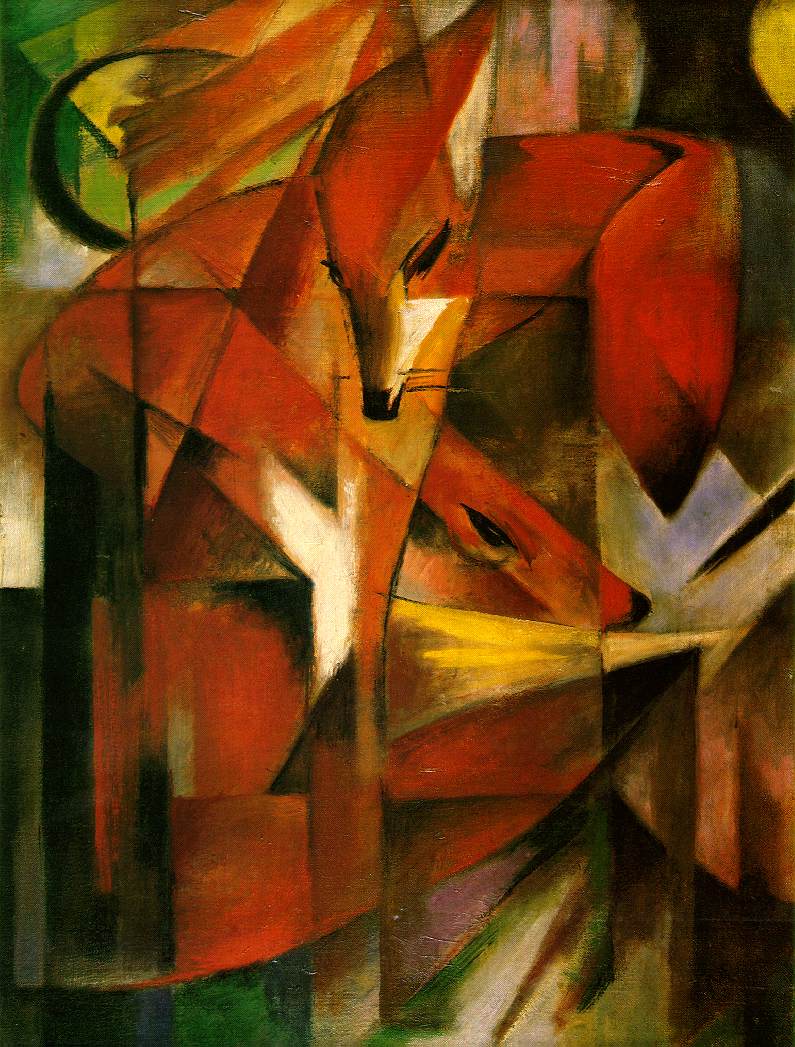
I have the fantastic opportunity to participate in a friend's thesis vocal performance for her Master's by providing a powerpoint of images from the period/artistic movement her performance relates to. It allows me to reiterate my love-love-love for German Expressionist Franz Marc and his colorful, dynamic, segmented animal paintings/drawings. Here at the museum, we have a watercolor sketch of four foxes by him that I fell in love with immediately. These Foxes (1913) at right are not that image, but it gives you the idea. :)
Foxes, 1913, Oil on canvas, 87 x 65 cm, Kunstmuseum, Dusseldorf. Via.

Fine Art in High Fashion.
When googling 'art in fashion,' this was one of the incredible pieces I found. Dior, in their exhibit Inspiration Dior at the Pushkin Museum in Moscow in 2011, amassed an unbelievable fashion collection for display. If you follow the link, you can even view the exhibition itself in 360 degrees like you're there. The piece that blew me away, made known from Wicked-Halo.com was this...Dior's tribute to Japanese print-maker Hokusai's ultra-famous The Great Wave off Kanagawa, 1829-32. The collection looks at other 19th-century art works as fashion inspiration as well, including works from Gauguin, Matisse, Picasso and others.

 Franz Marc was born in Munich on February 8th, 1880, son of a professional landscape painter. His formal training as an artist began at age 20 at the Academy of Fine Arts in Munich, continuing informally in Paris from 1903-1907. In 1911, he founded Der Blaue Reiter (The Blue Rider) journal, which developed into an artist's circle with Wassily Kandinsky and August Macke, among other German artists. He organized exhibitions under the Blaue Reiter name in 1911 and 1912. He was heavily intrigued by Vincent Van Gogh and those of the Impressionist movement in France.
  Tragic as his end was, it is what he accomplished in life that we want to remember! Der Blaue Reiter group believed that art should suggest spiritual themes. Marc chose to depict animals because he believed them to be more noble and natural than humans. He gave emotional meaning to what he painted, particularly with the colors.
  In this painting, Rehe im Walde II (Deer in Woods II, 1914), Marc represents a family of deer crouched in the woods. The blue deer is the buck, the masculine leader of this little group. The fawn is in yellow, symbolizing the joy of a child. The doe, in red, has changed its symbolism here to mean femininity and motherhood. As Marc previously believed that red symbolized "matter" and earth, it's easy to see how he could make the leap to encompass motherhood.