Showing posts with label fashion. Show all posts

Friday, March 23, 2012

Art Obsessions

I thought I'd use this opportunity to highlight a few of the (ART) things I am REALLY stoked about right now.

Cave to Canvas.

An online Art Historian/friend of mine runs another incredible Art History blog called Cave to Canvas. I highly recommend you check it out. She produces such a varied collection of art works/artists...there's something for everyone, and I think you'll discover new art interests you never knew you had! Her blog is great exposure to the art world....Go visit!


Franz Marc & German Expressionism.


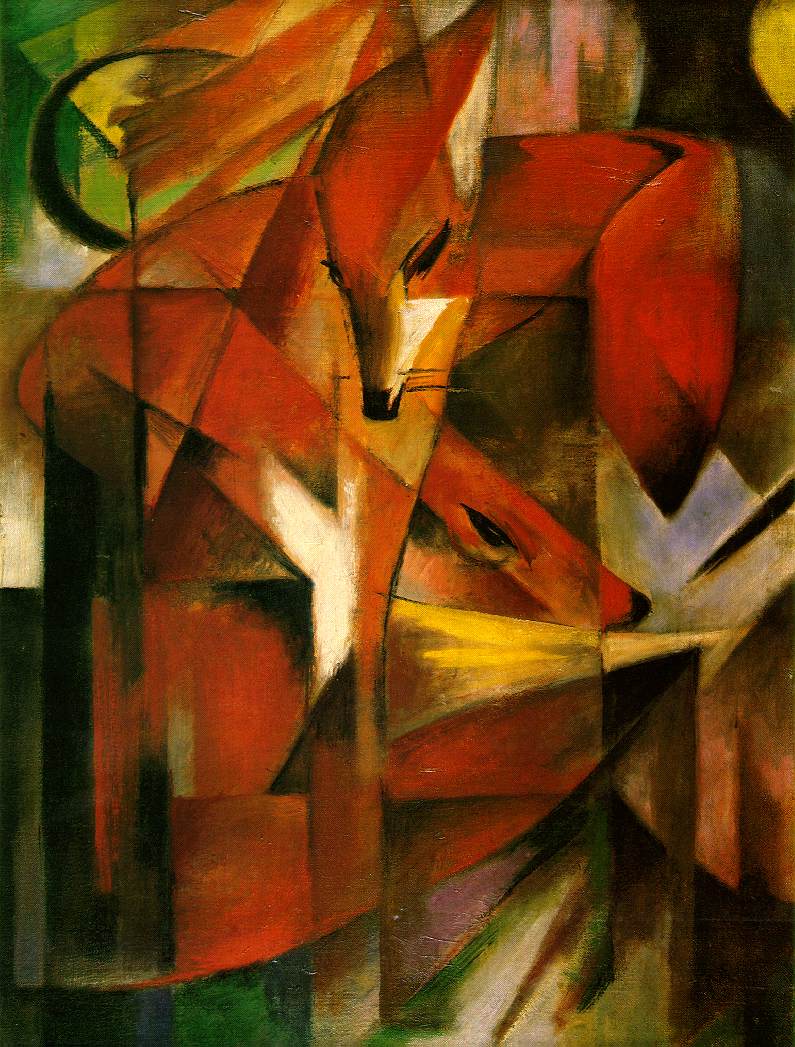
I have the fantastic opportunity to participate in a friend's thesis vocal performance for her Master's by providing a powerpoint of images from the period/artistic movement her performance relates to. It allows me to reiterate my love-love-love for German Expressionist Franz Marc and his colorful, dynamic, segmented animal paintings/drawings. Here at the museum, we have a watercolor sketch of four foxes by him that I fell in love with immediately. These Foxes (1913) at right are not that image, but it gives you the idea. :)

Foxes, 1913, Oil on canvas, 87 x 65 cm, Kunstmuseum, Dusseldorf. Via.


Fine Art in High Fashion.


When googling 'art in fashion,' this was one of the incredible pieces I found. Dior, in their exhibit Inspiration Dior at the Pushkin Museum in Moscow in 2011, amassed an unbelievable fashion collection for display. If you follow the link, you can even view the exhibition itself in 360 degrees like you're there. The piece that blew me away, made known from Wicked-Halo.com was this...Dior's tribute to Japanese print-maker Hokusai's ultra-famous The Great Wave off Kanagawa, 1829-32. The collection looks at other 19th-century art works as fashion inspiration as well, including works from Gauguin, Matisse, Picasso and others.

Thursday, February 23, 2012

Pounamu Tāonga...The Maori Hei Tiki.

Am I on a roll lately, or what? February is making up for my lack of posting in January, that's for sure.

At work, we were planning an ad for a local magazine, and were trying to find pieces in the museum's collection to emphasize. One of my favorite options was this one, a Hei Tiki pendant from New Zealand, created by the Maori peoples. It is the most brilliant green (I'd describe it as a cloudy emerald color), and its eyes are made of haliotis (abalone) shell, which really shines. In New Zealand, this shell is called a paūa shell.


Oceania
Maori peoples, New Zealand
Pendant,
Hei Tiki
Nineteenth century
Nephrite, haliotis shell
H. 9 in. (22.9 cm)
Raymond and Laura Wielgus Collection,
Indiana University Art Museum

I traveled to New Zealand as a People to People Student Ambassador when I was 13. The trip left an indelible mark on me, and spending time with the Maori was one of the incredible experiences. If you are a parent reading this blog, I must absolutely recommend to you that you allow your child the opportunity to participate in one of these international leadership adventures. It helped me grow as a person and become more aware of the world, instead of just myself.

But back to the art.

Foy Brothers, Thames, Young Maori Woman with Moko Wearing Korowai Cloak and Hei Tiki, c. 1872-86, Albumen carte-de-visite photograph, 10.5 x 6.3 cm. Via.

The Indiana University Hei ("something suspended from the neck") Tiki ("human figure") is superficially very similar to most other hei tikis I discovered in my brief look around the web. Most are made of nephrite ("pounamu"), a type of jade, and have eyes inlaid with paūa, like I said. These pendants are considered a tāonga, or "treasure."

Most are either sexless, or female. The British Museum writes that the significance of these tiki is unclear, but it has been suggested that they promote fertility or represent one's ancestors. They can be passed down through families through generations, and sometimes are given names. They are worn by both men and women, though I only have pictures of women wearing them to show you today.

Rotorua, New Zealand, Iles Photo, Young Maori women with moko (facial tattoo); wearing a kahu huruhuru (feather cloak), a huia feather in her hair, and a hei tiki (neck pendant), 19th century, Gelatin silver print. Via.

The markings under the lips of the two women in these photographs are a type of body art called Ta Moko. These markings symbolize achievement, adulthood, and aristocracy. As with most forms of tattoos and body art, the process doesn't sound particularly pleasant (chiseling skin open and applying charcoal into the gouges). This practice is not limited to the face, but can, in some occasions, encompass the entire face (usually on men). This tradition carries on even today.

This website that I found suggests a connection between these tiki and the Gorgons of Greek mythology. An interesting read!

Tuesday, December 27, 2011

The Art of Fashion

I've had a couple of entries emphasizing fashion as an art form. Now, fashion is taking art on as its inspiration. Check these prints coming our way in the spring!

Some of you may know of Yves St. Laurent's day dress interpretation of the work of Mondrian from 1965. So, this combination of art and fashion has been a long time established!

But let's look a little more currently.

The work of Vincent Van Gogh, though thoroughly under-appreciated during his own time, is probably one of the most, if not the top, symbol of fine art that our era knows.

And Rodarte designers Kate and Laura Mulleavy have decided to procure his imagery for their 2012 spring line.

Following suit, Jil Sander designer Raf Simons has referenced Picasso's modernist ceramics for their spring line.

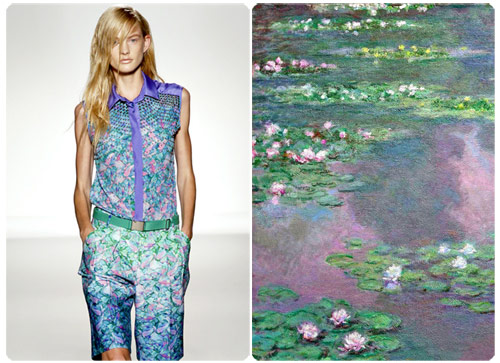
The blurred florals and emphasis on lavenders and greens from Monet's Waterlilies were referenced in Sportmax's spring line.

Floral headpieces, dangling earrings, and structured masculine-feminine silhouettes at Moschino draw inspiration from Mexican painter, Frida Kahlo.

Finally, Dior has paired up with German painter-sculptor Anselm Reyle to create a 40-piece collection of clutches, platform shoes, makeup, and nail polish.

"Art is at the center of our brand," says Delphine Arnault, deputy general manager of Dior.


Gotta love acknowledged appreciation like that. :)

Tuesday, October 25, 2011

Sustainable, functional, "yet very chic"

I found my next fashion designer of note for ya'll by complete accident - a completely JOYFUL accident. But with one look at Norweigan designer Leila Hafzi's creations (only enhanced by her eco-friendly mission), I was absolutely smittened.

Hafzi's Debut designs from 1997 were created in Nepal. This highly ecological collection worked with fabrics such as hemp and nettle, loomed raw silk, wood, and buttons and embellishments made of bone or horn from water buffalo. This collection paved the way for Hafzi's enduring mission: To promote organic and ethical trade in the high end fashion industry, to represent this movement, and to develop an entirely environmentally friendly production cycle for fashion in the future.

UTOPIA collection, Spring/Summer 09

And her creations only get better with her experience! Looking through her oeuvre on her website, I'm amazed at the variety and dynamism of her designs, given her commitment to use sustainable, functional materials. You see everything from exceptionally structured, dense fabrics and pieces (Natura), to sheer cashmeres, mohair, and elegant brocades (Studio Earthling, Aeon Afterglow), to the most gorgeously flowing gowns (UTOPIA, Néktar). Some of her pieces can be exceptionally modern and accessible, while others are the perfect fit for a daydreamer with a romantic eye.
Néktar collection, Spring/Summer 2010

And the COLOR. This woman is NOT afraid to use color, and bless her for it!

Néktar (pictured a lot) and UTOPIA are probably my favorite two collections. They're very whimsical, colorful, and romantic. Néktar incorporates colors from hand-picked flowers and draws inspiration from hummingbirds and flamingos in a "lush Kathmandu garden." UTOPIA is inspired by animals of Tibetan mythology and the seventies, and combines the visions of Hafzi, Marcus André Green, and tattoo artist Mike The Athens.

Néktar collection, Spring/Summer 2010
At the heart of her glorious collections remains her strong, adamant mission:

"There is no doubt that the production of an eco-collection is more time consuming and the costs are much higher, but in the end, how high is the price of producing a collection compared to adding one small step towards the achievement of saving our planet and eventually mankind?"

"I think it is important for artists and creative people to emphasize global awareness regarding our responsibility to preserve the earth we are about to destroy."

"For me, it is a balance between creating works in developing countries, establishing a long term market position, and then step-by-step making fully ecological collections."

Néktar collection, Spring/Summer 2010
WANT.

Hafzi's brand style is based on Tibetan monk drapery, seventies glam, and Greek goddess-like gowns. Her favorite color is ever changing with the rainbow, the base colors of her collections not developed from predicted trends but rather from what she feels at the time would be "prettiest" and the most ecologically possible to create.

Roy ay e Sefid ("Bright Dreams") Bridal collection

Hafzi's even taken the leap into wedding fashion! Gorgeous, amazing, incredible designs with presence, flow, and unique charm. Fashioned from silk organza, silk chiffon, or hand-painted silks, floral applications and hints of blush pink, champagne, lavender, and peach give these gowns an incredible femininity. This is a new spoke in her fashion wheel and thus far, appears a success! Any dress found in this collection can be dyed for a Red Carpet (or other) occasion to preserve the brand's commitment to sustainable fashion.

Saturday, July 16, 2011

"Cool has become formulaic."

Another fashion post has been a long time coming! If you'll recall, my last two fashion posts focused on African designers Serge Mouangue (combining African & Japanese aesthetics) and Nkhensani Nkosi & Stoned Cherrie (a modern South African women's line). I can contain my love for this next genre no longer...Indian fashion! I don't think there is anything so lovely!

My images focus on the bridal fashion for this particular designer. They're more traditional, but this highly versatile designer's works go from the most seemingly traditional to the exceptionally contemporary. Plus, I wanted to touch back on the Bridal theme I started in late June. :)

Ritu Kumar - Indian Fashion Brand

Yes, these are wedding garments. (I'll take one, please!)

Since 1969, Ritu Kumar has established her fashion brand as one of the largest and greatest in India. She translates traditional fabrics, decorations, and craftsmanship into modern terms and unique fashion creations. According to her website, the brand is known for the quality of their fabrics and embroideries, the colors (the video below mentions treating bridal gowns in pastels instead of the typical vivid red), and "gloriously rich Indiana aesthetic."

Ritu Kumar has been retailing in India and on an international scale since the 1970's while their main production centers operate out of Gurgaon and Calcutta. This brand was the first to introduce "boutique culture" into India (hence why I thought it was important to start here :)). The brand encompasses haute couture, a fashion forward sub-brand called LABEL Ritu Kumar, a bridal collection, accessories, and fragrances.

In October of 1999, Christie's of London published Kumar's first book, an academic fashion text called Costumes and Textiles of Royal India. This book chronicles the history of fashion in India from royal patronage to present. Kumar seems to take a great interest in educating the public on Indian fashion as much as providing it for them. Her website is complete with a glossary of Indian fashion terms that is a great way to start learning!

Ritu Kumar's Couture is your more traditional Indian styles. Long, full skirts and bell sleeves, sheer, embroidered shawls...an abundance of gorgeous fabric in every gown and detail that would take you years to study!

LABEL Ritu Kumar expresses contemporary, new, and western styles with Indian craftsmanship and fabrics. Mini dresses, no sleeves, very modern!

The vibrant colors, the intense attention to detail, flowing fabrics, attractive patterns... Gorgeous Indian works of fashion would make any girl feel like royalty! Contemporary Indian designers, like those from Africa, are finding new and exciting ways to retain their native fashion traditions while adapting to the modern era! I've personally seen that Indian motifs and styles are making their way into Western culture and I think they could have a really big impact on the world scale in the future!


Though none of the images I shared with you today contain denim, this was Mrs. Kumar's take on denim...Ladies, would you agree?

"When women wear denim it (the derriere) must look elegant. It's the second thing every woman looks at in the mirror, but it's the first thing she cares about. She does that half twirl, her back arched and her head craned around. If the jeans are right, the experience is transforming, like putting on a magic cloak."
- Ritu Kumar