Ya'll know I recently became infatuated with John Singer Sargent. Ya'll also already know that I'm writing a paper about his flamenco dancers for my American Art class. In the course of my research, I came across a painting I had never seen as a part of his oeuvre (body of work) and wanted to share it with you not just because it's one of the most beautiful paintings I've ever seen, but also because the focal figure is a constant in his early work.
It's always fun to find a reoccurring theme/figure in things, right :)?
 This is Dans les Oliviers, á Capri (1878) featuring then seventeen-year-old Rosina Ferrara, an Ana-Capri girl. It's 31.5 x 25 inches, oil on canvas, and there are three versions. Two are in private collections and one is at the Museum of Fine Arts in Boston. This picture doesn't really do it justice...the golds, her pink skirt, the deep greenblue-gray of the trees are much more vivid. I wish I could see it in person!
I think what makes me love this picture is the almost dream-like quality it has. Rosina is draped over a gnarled old olive tree amidst an overgrown olive grove. She is kind of entwined with the tree, making her a part of the magical landscape. The streak of her pink skirt gives the painting a visual pop. All of the background is in some kind of mystic haze, while Rosina and her tree the only truly defined elements. Some scholars have suggested the tree is a stand-in for Sargent, the artist playing the undepicted male half of a romantic pair.
The piece is kind of wild and magical and Sargent has really captured grace, mystery, and beauty all in one painting.

I first saw Rosina in this picture, called Capri (1878). In this work, she is dancing on a hotel roof at what could to be cool-colored twilight OR bright illumination from a full moon . She is accompanied by a friend playing a tambourine and she is swept up in the dance, pink skirted hips swaying right as her gracefully raised arms swing left. Supposedly, the dance she is performing is called the tarantella, an energetic dance of whirling steps that depicts a love story.
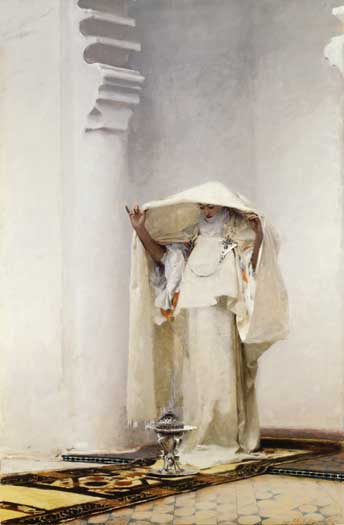
Sargent first really established himself as a proficient through the Fumée d'ambre gris (1880), which I mentioned in the previously article, an exotic orientalist portrait of a woman all in white, surrounded in white, scenting her clothes with the aphrodisiac ambre gris. I'd argue that Capri is a precursor to that success, a practice in the different shades of white.
 In my sources, it's not identified whether or not this is actually Rosina, but I would argue that it is based on the pink skirts, the up-do, and the fact that in the following picture, she has onions strung over her shoulder. This work, called Stringing Onions (1878), is a warm, quiet working scene...the women are confined in their space, but the golden white walls and large window make the atmosphere warm instead of oppressive.
This portrait of Rosina (1878) has her in her typical Capri dress, onions slung over her right shoulder, and hand on her hip, a traditionally Sargent pose. Furthermore, the hand is bent at the wrist, so it is the top of her hand that connections with her hip while her palm faces the viewer. See if you can pose your hand as such so you'll see what I mean. Sargent does have an affinity for these contorted, uncomfortable gestures...you'll see poses like this more and more as you continue historically through his oeuvre! (Rosina's backward reaching arm in Dans les Oliviers has a similar stretch, in theory, to Madame X's backward reaching arm)

Born in 1861, Rosina Ferrara was born in Anacapri, Capri. She was described by the artist Charles Sprague Pearce as "the tawney skinned, panther eyed, elf-like Rosina, wildest and lithest of all the savage creatures on the savage isle of Capri." I sure hope he meant it, and she took it, as a compliment. Rosina was painted by other artists, but of the 16 known paintings of her (that I could find), 12 were done by Sargent (I am skeptical of two of those, however). One of the artists to paint her, George Randolph Barse, later became her husband in 1891. She died in New York in 1934 of at age 76 of pneumonia.

 Lady with a Rose (1882) of Charlotte Louise Burckhardt was the first portrait to really strike me. Here Charlotte is pictured in all black on a neutral, unremarkable background which emphasizes her as the focus of the piece. In her extended left hand, she gingerly holds a wide rose between her thumb and forefinger. The innocent white of the rose plays off the blackness of her dress and the dirty-drab background so nicely. My favorite part of the whole thing though is her facial expression. Her lips are quirked in the sassiest of smirks and the look in her eye suggests she's merely humoring Sargent rather than willingly playing a part of this whole scenario. She has personality, she has spark, and you want to ask her story! And you didn't need a fancy background or a colorful dress. You just needed her, being her, and holding a flower.
 Sargent studied under the French painter