Tuesday, February 14, 2012

14 ways to fall in love

Happy Valentine's Day to all! Even if you're not a big fan of the Hallmark holiday (I never used to be), this is a great time to remember and appreciate all of the types of love in your life - from and for parents, siblings, relatives, friends, even pets or compassionate strangers. But this day just wouldn't be its pink and red, glitter and chocolate-coated self without some strategically placed mushiness and PDA.

So, I've compiled for you my (personal) Top 14 Romantic works of Art. I organized them chronologically, beginning with the earliest piece, running to the most recent. Fourteen pieces for this fourteenth day of February, which might as well be Valentine's MONTH. Hope you enjoy. :)

Psyche revived by Cupid's kiss, Antonio Canova, 1787. via.

I love this piece. I got to see it in the Louvre in November 2007 and was absolutely taken with it. I believe this sculpture captures the moment when Cupid revives Psyche after she opens a box she believed to be filled with beauty (it was actually filled with eternal sleep), a trick conceived by Cupid's mother, Venus, in order to destroy their love. I love this piece and story a) because Cupid and Psyche's love is one of the -only- it seems like in Greek mythology that actually survives all odds, and b) their embrace is just so sensual! The piece has elegant flow and movement, as well as a breath of life. Their adoration is obvious from their embrace.


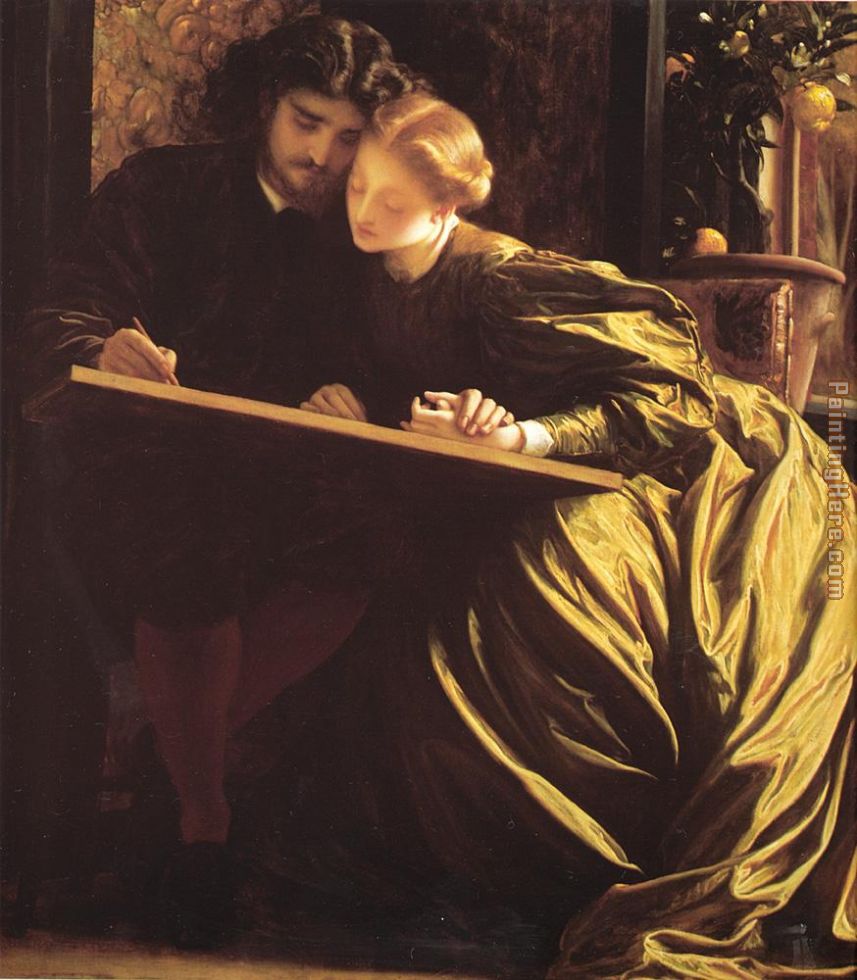
Painter's Honeymoon, Lord Frederic Leighton, 1864. Via

Truth be told, I just found this piece today. But I love it. Love, love, love it. The painter and his bride are sweetly nestled together, cheek to cheek, hands intertwined as he works and she adoringly watches him. His board is even tilted towards her for her to see. It's a moment of peace, affection, and shared art. How precious!

Spring, Pierre Auguste Cot, 1873. via.

A lovey double couple sharing a swing with spring in full bloom. He's smiling at her with affection, and she's simpering up at him like they're sharing a secret. What's not to...love?
Ha, see what I did there?

Putto's Kiss, Émile Munier, 1873-1895. Via.

Sweetness personified!! Two child-like putti share a hug and kiss. I love that the little girl putti has butterfly wings instead of the typical angel wings. She's obviously not sure of her interest, but he's sure of his! Good for you, little putti-guy.

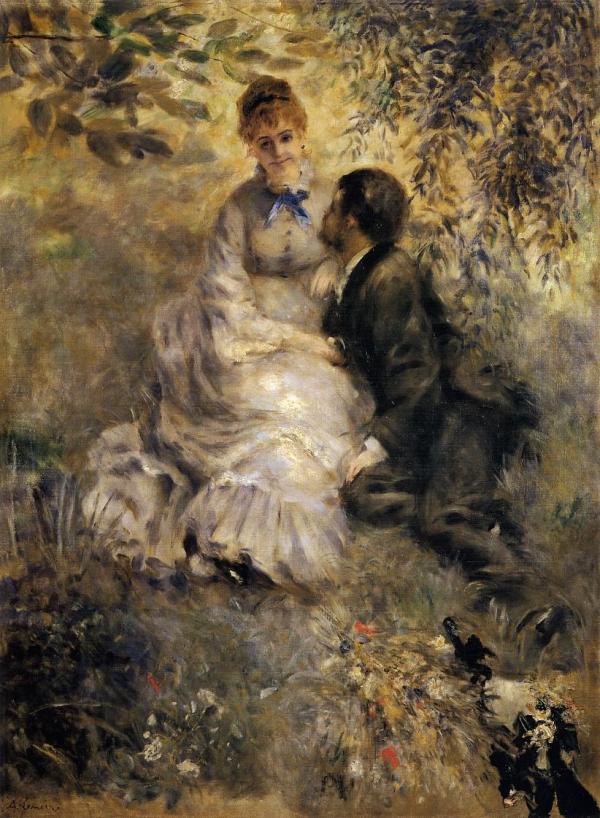
The Lovers, Pierre August Renoir, 1875. Via.

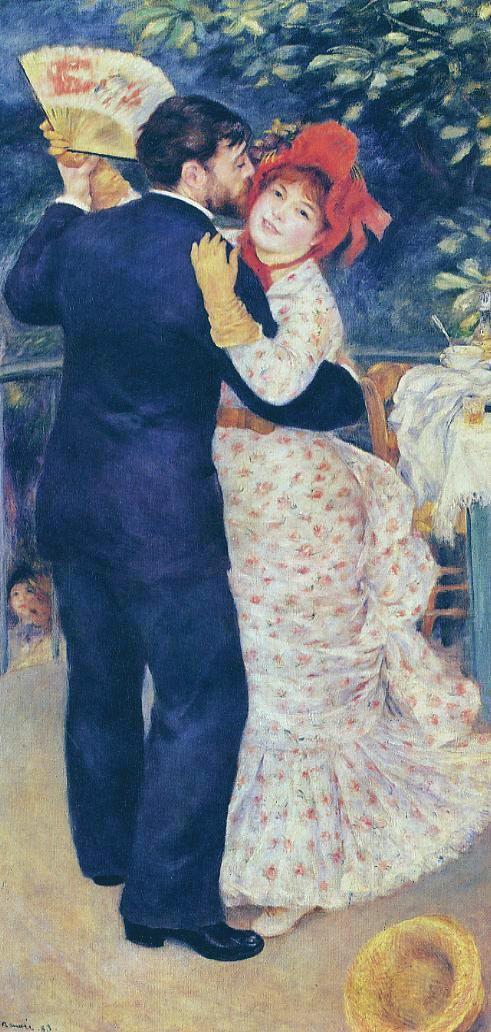
Mmm, a vibrant garden landscape wrapping its luscious arms around an amorous couple...You know, a sweet, well-behaved amorous couple. Renoir's brushstrokes really dynamize, and simultaneously soften, the scenes he paints. In a few of Renoir's paintings of couples, the women are looking out at the viewer while the man is focused on her (i.e. The Engaged Couple and Dance in the Country) . I think that's really interesting that he uses a relationship between two people to engage an invisible third.

Romeo and Juliet, Sir Frank Dicksee, 1884. Via.

This painting, voted UK's 'most romantic work of art' this year, is of the famous balcony scene from our favorite tale of star-crossed lovers, Romeo and Juliet. The scene is framed by an architectural arch in this imaginary world, pulling the viewer into this secret love trist. She throws both of her arms around his neck as he leans toward her and their lips lock passionately.

I have to agree: That's a pretty darn romantic work of art.

The Kiss, Auguste Rodin, 1889. (Photo by me)

On every site that I have seen gauging the most romantic works of art, and according to most of the people I know, if this marble sculpture by Auguste Rodin isn't the most romantic piece of work, it's the second. Two seated nudes, the female's arm linked around her lover's neck and her right leg draped between his, while his right hand rests on her hip, their lip lock in the most passionate of ways! Since it appears to be a universal favorite, I decided to include two shots of it...also because I took both photos and I couldn't decide which view you needed to see more. :P

Behind the completed work in this photo you can see one of Rodin's studies for it. He obviously had this idea for a while and worked it out in quite a few studies before the finished product. This magnificent work is surprisingly kind-of situated in a corner of the Musée Rodin in Paris, perhaps not giving it it's proper due - But if you appreciate it's love message, you will appreciate it no matter where it sits.

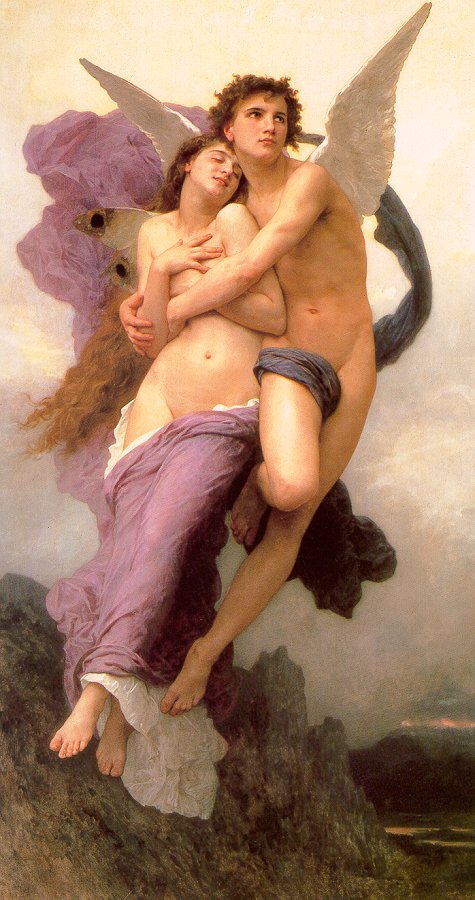
Abduction of Psyche, William-Adolphe Bouguereau, 1895. Via.

It's Cupid and Psyche again! After all, what is the lover's holiday without the god of love?

For an "abduction" scene, let's face it - Psyche seems really into it. Cupid looks upward, determined, his arms wrapped protectively and confidently around his lady love. Again, we see little butterfly/moth wings on the lady to contrast the angel wings of the man! (I guess it was a known thing during this time?) She seems wrapped in ecstasy just as much as in his embrace.

The Kiss, Gustav Klimt, 1907-8. Via.

This piece reminds me of my college roommates, who hung it in their common area. An interesting abstract piece that really shows how two people cherish one another. I used to think they were cozy, snuggling in bed. Not sure if that's true or not. If so, that's a really nice, sparkly gold bed they have there. But I love how he sweetly cradles his lover's face in his hands. :)

The Kiss, Constantin Brancusi, 1912. Via.

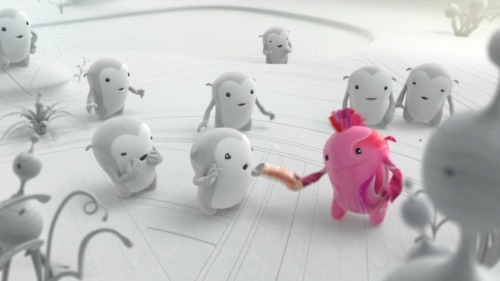
Another Kiss! This time, even more abstract, if not primitive looking. But I think it's kinda cute. :D Not sure how Brancusi would feel about me calling his sculpture "cute," but I can't help myself. It makes me think of those little minions on the Poptart commercial or in the Despicable Me movie. Adorable, smooching little minions.

Birthday, Marc Chagall, 1915. Via.

Here, a stunned-looking little lady gets a smooch from her levitating, beyond-yoga-flexible honey. She truly seems surprised about the sign of affection in celebration of her birthday...but she shouldn't be surprised! He seems rather "head over heels" for her. ;)
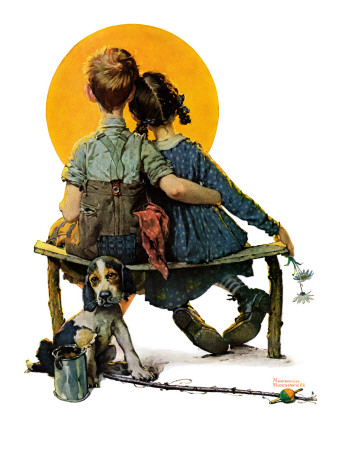
Sunset, Norman Rockwell, 1926. Via.

Mew! Isn't this just the sweetest? From the daisies to the bored puppy to their little heads nestled together. Sweetest. This piece is also called "Little Spooners." I had a difficult time choosing between this, After the Prom (1957) and Four Seasons of Love (1972). But the innocence of this love was just perfectly captivating.


The Kiss, Roy Lichtenstein, 1962. Via.

Yet another kiss! And again (and without surprise), looking very into it....

Dance me to the End of Love, Jack Vettriano, 1998. Via.

The finale! Elegant and romantic like a Cary Grant movie. Two lovers face a light while others dance in the distance. It's like they're preparing for the future, for the journey of love, for walking (or dancing) into that light together. Dressed to the 9's, they're ready to conquer the world....together.

"In our life, there is a single color, as on an artist's palette, which provides the meaning of life and art. It is the color of love." - Marc Chagall

Sunday, January 15, 2012

Sans Titre

In my last post on art at the Musée des Beaux-Arts in Quebec, I mentioned Marcelle Ferron who was a painter and a stained glass artist. It was her painting Return to Italy, no. 2, that truly inspired me and my Dad. The vibrant colors, incredible texture, and imaginative possibilities are gripping! So, I thought I'd share some more of her paintings with you all, though you should definitely take a look into her stained glass work too.


Sans Titre (no.166)
Oil on panel
1947
25 cm x 37 cm

Sans Titre
Oil on canvas
1956
115.6 x 71.9 cm


Les Barrens
Oil on canvas
1961
161.2 x 129.5 cm


Sans Titre
1963-4
Oil on canvas
31 x 42 cm


Sans Titre
1973
Oil on canvas
57.5. x 44.8 in


Sans Titre
Oil on Canvas
1985
39.5 x 31.875 in

"Too many people buy art to collect and hide away, the joy of art is in it being shown and appreciated." - Marcelle Ferron

Saturday, December 31, 2011

To end 2011

Wow! I cannot believe it! This blog has been up and running for an entire year (almost) now...and I made my goal of 52 entries for you on art! Sure, it wasn't literally an entry a week, but hopefully you learned and enjoyed some of what I had to share along the way.

I won't limit myself by ending the blog since the year is ending...I know 2012 will have just as many art wonders to share! So, cheers to a new year...May you be blessed and joyful in this next year full of adventure, learning, and hopefully, art!

For my last entry in 2011, I wanted to share some pieces for you that I really enjoyed at the Musée National des Beaux-Arts in Quebec City. My family got the wonderful privilege to visit this gorgeous city (If you live in North America and can't go all of the way to Europe, but want to experience that kind of culture and atmosphere...go to Quebec!). It was a LOT colder than we were used to (-7 degrees the morning we left...-21 degrees with windchill!), but it was a great trip. Visit, visit!

This first piece is the unfinished, monumental, epic Apotheosis of Christopher Columbus by Napoleon Bourassa. It was uncompleted when Bourassa, a prominent Canadian architect, painter, and writer, died in 1916. His architectural works are some of his most incredible inventions, in my opinion, but I was awed by the size and details of this work, so I thought I'd share it. Figures in this piece include everyone from Queen Isabella of Spain to Copernicus to George Washington to Leonardo Da Vinci. It was inspired by works such as the School of Athens by Raphael.

This work is called Espagne (Spain), and was done by Automatist painter and sculptor Jean-Paul Riopelle. This image does nothing to convey the tactile quality of the actual work, which is very dynamic texturally as well as coloristically. His other two works that earned quick love from our family were Sun Spray and The Green Parrot.

One of the gems of the Musée is their Inuit Art collection. We saw incredible carvings, mostly, but some drawings as well. Our hands down favorite pieces were those of the dancing polar bears, like seen above. There were sculptures also of polar bears swimming (which looked absolutely life-like!), musk oxen, wolves, whales, half-woman/half-fish gods, and hawks. Materials used ranged from caribou antler to serpentinite (a gorgeous green stone) to whale or narwhal bone. The other most incredible piece was a narwhal ivory horn carved top to bottom with swirling animal and human imagery. Incredible detail and it was great to learn about a culture that doesn't get a lot of exposure.

My favorite piece (my Dad's too) was actually discovered before even going to Quebec. This is Return to Italy, #2 by Marcelle Ferron (1954), a piece from the museum's Abstract and Figurative Art collection. I just adore the rainbow of colors in this piece (it expresses all kinds of emotions!) and the texture and flow of the spatula/knife strokes are really something else. She was a stained glass artist as well as a painter. I find her work to be inspiring and this is the type of painting, were it in my house, I could look at, adore, and be inspired by every day. :)

Mon propos a toujours été modeste, je voulais transformer ce mariage de raison en un mariage d'amour. - Marcelle Ferron

("My aim as always been modest; I wanted to transform the arranged marriage [of art and architecture] into a love match.")

Tuesday, December 27, 2011

The Art of Fashion

I've had a couple of entries emphasizing fashion as an art form. Now, fashion is taking art on as its inspiration. Check these prints coming our way in the spring!

Some of you may know of Yves St. Laurent's day dress interpretation of the work of Mondrian from 1965. So, this combination of art and fashion has been a long time established!

But let's look a little more currently.

The work of Vincent Van Gogh, though thoroughly under-appreciated during his own time, is probably one of the most, if not the top, symbol of fine art that our era knows.

And Rodarte designers Kate and Laura Mulleavy have decided to procure his imagery for their 2012 spring line.

Following suit, Jil Sander designer Raf Simons has referenced Picasso's modernist ceramics for their spring line.

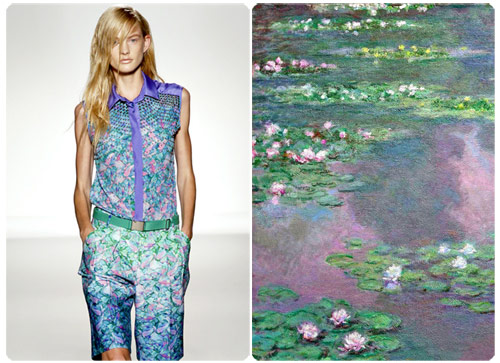
The blurred florals and emphasis on lavenders and greens from Monet's Waterlilies were referenced in Sportmax's spring line.

Floral headpieces, dangling earrings, and structured masculine-feminine silhouettes at Moschino draw inspiration from Mexican painter, Frida Kahlo.

Finally, Dior has paired up with German painter-sculptor Anselm Reyle to create a 40-piece collection of clutches, platform shoes, makeup, and nail polish.

"Art is at the center of our brand," says Delphine Arnault, deputy general manager of Dior.


Gotta love acknowledged appreciation like that. :)

Tuesday, December 6, 2011

Angels we have heard on high

In honor of Christmas, I was thinking about what kind of posts I could do in keeping with the season. Angels were the first thing that came to mind. And of the angelic art I knew, given that I've touched on a Renaissance/Baroque lately, I thought I'd go the direction of more modern.

These angelic depictions are the work of Abbott Thayer, a prominent American artist that lived from 1849 to 1921. His angels are subdued and reserved, draped in flowing white or goldrenrod gowns, framed back their fluffy white feather wings. Oftentimes, these "ideal" women depict virtues.

Angel. 1887. Oil. Smithsonian American Art Museum.

This is probably his most famous angel. Her pursed lips, as if stifling a smile, is a curious look for an angel, but it was his way.

Winged Figure. 1889. Oil. Art Institute of Chicago.

When asked about the meaning of his angelic figures, this was Thayer's reply:

"Doubtless my lifelong passion for birds has helped to incline me to work wings into my pictures; but primarily I have put on wings probably more to symbolize an exalted atmosphere (above the realm of genre painting) where one need not explain the action of the figures."

Winged Figure Seated Upon a Rock: Stevenson Memorial. 1903. Oil. Smithsonian American Art Museum.

This painting actually commemorates the author Robert Lewis Stevenson. On the rock this angel sits upon, VAEA is inscribed, while there is a firework in the darkness behind her. VAEA refers to a mountain top where Stevenson was buried after his death in 1894.

The painting is an excellent example of extreme light and darkness, gladness and sadness, good and evil. This was appropriate, both for Thayer to paint (with the main emotional and spiritual levels behind his work and style) and to represent Stevenson, who often wrestled with these themes in his writing.

Angel Two.

Thayer's story is actually a pretty sad one...I'm sure you could probably tell by the subdued nature of his angels, and the reasons why will be touched upon below. Despite the personal tragedy and grief that tinted his life, Thayer was positively received in the public art scene and that's why many of his pieces exist in American museums today. You can read more about his story on Wikipedia if you're interested.

A Virgin. 1892-3. Oil. Freer Gallery of Art.

I included this picture in the collection A) Because the "Virgin's" pose directly references the Nike of Samothrace, my beloved sculpture I'm in the process of writing a paper about. And winged Nike is certainly a type of angel.

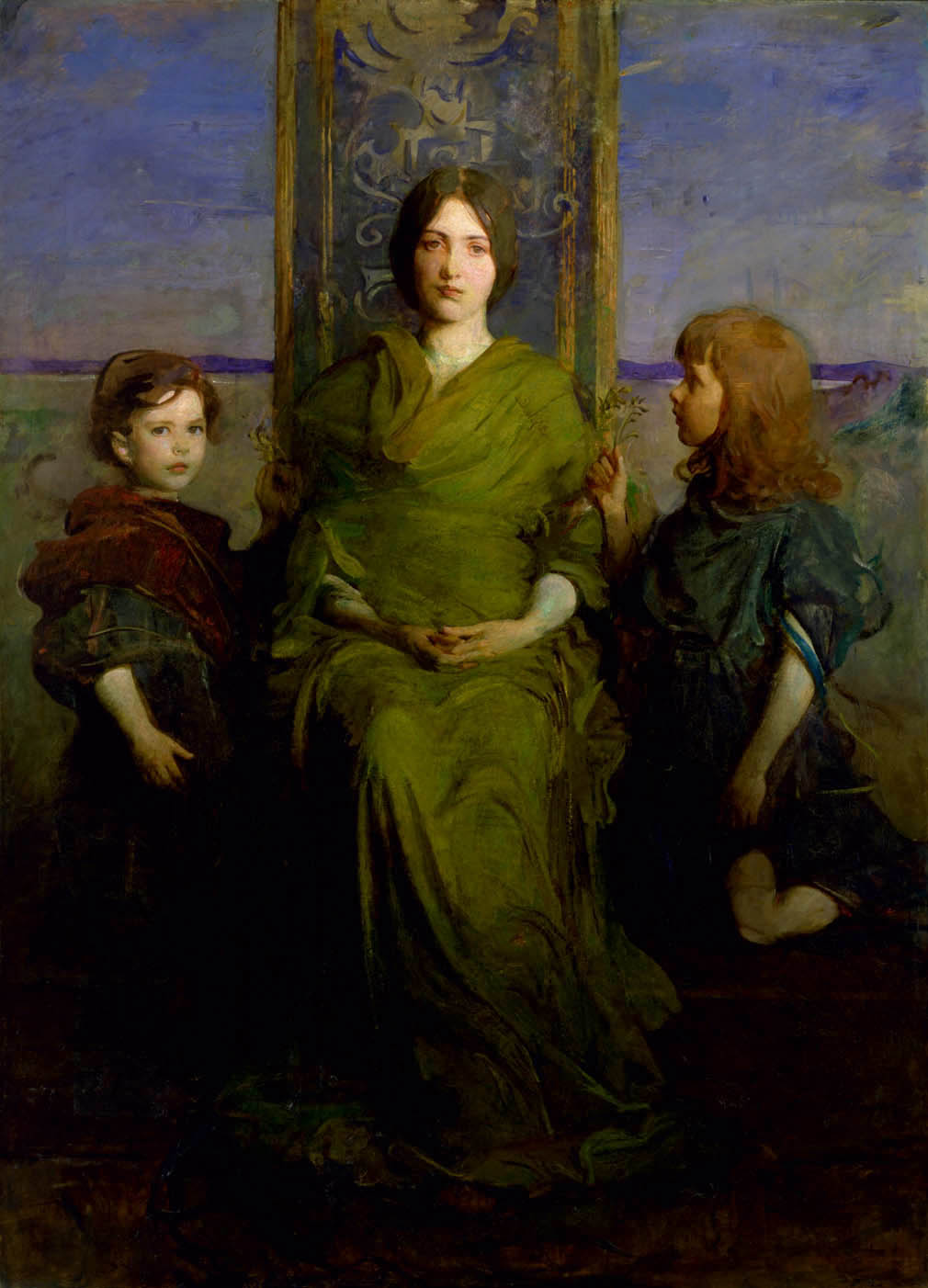
B) It's obvious the "Virgin" is the same model as the first angel from 1887. According to this article on Thayer, therapy, and the angels, the Angel is his eldest child, Mary. The two young children at her sides are her younger siblings, Gladys and Gerald. This painting was done the years after their mother, Kate, passed away from "irreversible melancholia" in an asylum, a downward spiral enacted by the deaths of two of their sons in the 1880s and her father in 1891. The article suggests tuberculosis may have been the actual reason.

After Kate's passing, the family became hyper vigilant about health and attention to nature, secluding themselves in rural New Hampshire within two weeks of her death. It is no wonder then that they are depicted on a brisk walk, barefoot, and out in nature. The surmounting clouds build behind them, appearing to rise from Mary's back, a testament to the 1887 Angel picture. In an earlier Virgin Enthroned piece, playing on the structures of Renaissance Christian art, Mary is playing the part of the Virgin (appropriate) and acting as a stand-in for her own mother, who is not present. The same is suggested in A Virgin...Mary is the stand-in mother, and Thayer's children are made sacred in referencing Mary's angelic depiction and embracing the therapeutic effects of Mother Nature.

Art was his form of therapy to cope with the tragedies in his life. His angels, the figures of another otherworldly realm, sacred and pure.

"It turns out I was my own art therapist all along...that deep, emotional churning that takes place when you feel powerless to change some things in your life, and you pick up a brush or a pencil and the focus transcends like a meditation." - Daniela Anderson

Saturday, December 3, 2011

Everybody Loves Art History (Part II)

Part II!

You'd be surprised where Art History can pop up when you least expect it. These are just a couple instances that I have found, though I can credit my delightful colleague Kimi for finding the Harry Potter connection and my lovely other colleague Alicia for deciphering the Holbein the Younger. Enjoy. :)

I've mentioned this happy find before, back in my entry on Caravaggio. I will admit without shame, as a former babysitter, I have seen most of (and actually enjoyed!) the Barbie movies. In Barbie Rapunzel, when the guests of the ball are entering the castle, they walk down a hallway hung with paintings and large scale drawings. I have yet to identify the rest, but the painting with the arrows directed at it caught my eye immediately as a Renaissance/Baroque Art Historian.
Caravaggio. Boy with a basket of fruit. 1593. Oil on canvas. 70 cm x 67 cm. Galleria Borghese, Rome.

Knowing Caravaggio's rather contentious, feisty nature, I have a feeling he'd be flipping in his grave to know one of his paintings is in a Barbie movie. I think this was a rather interesting choice on the part of the Barbie folks too...It's hyper realistic (there are scars and fungal spots on the fruit) and we have to admit, a little seductive with the boy's bare shoulder and sensual gaze.

The next piece is my pride and joy, mostly because it's the most recent connection I've found. As you can probably tell from the image, these paintings are to be found in Beauty and the Beast: The Enchanted Christmas.

A two for one screenshot!

The painting on the left was what caught my eye in the first place...mostly, because it's by my favorite artist, Diego Velázquez.

Diego Velázquez. Equestrian portrait of Philip IV. 1635. Oil on canvas. 301 x 314 cm. Museo del Prado, Madrid.

I love that in a lot of Velázquez's paintings, you can see lines where he added on additional canvas to expand his images or a "fifth hoof" on the horses because Velázquez would paint too fast and have to go back and fix them. You can see examples of both of those things here! (Expanded vertical margin is on the right...Fifth hoof is on the rear, farthest from you)

The painting on the right in the screenshot was a bit of a stumper...but thankfully, I have a friend that specializes in Northern Renaissance paintings!! (Thanks, Alicia!)

Hans Holbein the Younger. Portrait of Sir Richard Southwell. 1536. Oil and tempera on oak. 47.5 x 38 cm. Uffizi, Florence.

The B&theB screenshot lacks the text behind Southwell's head and is a cropped version of the actual painting, but I am convinced it's this one!

The next example was found thanks to my friend Kimi. Thanks, Kimi!

Lewis Chessmen (Uig chessmen). 12th century. Walrus ivory. British Museum and Museum of Scotland.

These walrus ivory chessmen were found on the Isle of Lewis in the Outer Hebrides, Scotland, in 1831. There are 78 original pieces, 67 of which belong to the British Museum and the other 11 belong to the Museum of Scotland. The chessmen were likely of Norwegian origin, as Scotland was ruled by Norway during this time in the 12th century. You can read more about them on Wikipedia. :)

And here, you can see that Harry Potter borrowed the Lewis Chessmen for their own chess game, Wizard's chess! Wizard's chess involves animated chess pieces that move on vocal command of those playing the game.

See the resemblance :)?

I love finding these art "easter eggs" in pop culture!

Thursday, December 1, 2011

Everybody loves Art History (Part 1)


Most probably just don't know it.

That's why I've dedicated this particular entry to how a knowledge of Pop Culture can make Art History more fun (Not that it isn't already a party!). The next entry, the Part II to this entry, will give a few instances where Art images have been hidden right under our noses in Pop Culture.

But for now...take a step inside my mind and let me share with you a few parallels I drew.

- Lamby don't care
El Greco's Modena triptych (If it is, in fact, his...So many problems with attribution in art history, you know) is a really gorgeous amateur undertaking for the young Greek painter. I think his treatment of all of the panels in such vivid red and golds, as well as browns and neutrals, in an exceptionally interesting way of interpreting the Christ story. Usually, we see many more blues and luminous whites and greens to balance the red. But not here.


Adoration of the Shepherds, wing of the Modena Triptych. El Greco. 1568. Historical Museum of Crete.


As in typical Adoration of the Shepherds images, animals are included in the scene. It was weird enough that the cow is a strange, fiery red orange. Pan to the weird upside-down sheep in the crook of the middle shepherd's arm.

Yes, that is, my friends, reportedly a sheep.

...Or is it?


Albino honey badger photo lovingly borrowed from this excellent wild life photographer.
Looks like an upside-down albino honey badger to me.

- Mt. Sinai = Mordor?!
DUHDUHDUH.

Mount Sinai. El Greco. 1570. 41 x 47 cm. The Historical Museum of Crete.

Thank you, El Greco, for giving us our first glimpse of Mordor.

Makes me a little uncomfortable.


- I feel like somebody's watchin' me
When one of my classmates presented this beautiful painting by Lorenzo Lotto, St. Nicholas in Glory with St. John the Baptist and St. Lucy, I did the common Art History nerd visual perusal, admiring the bold colors, lofty theme, and reverent figures. But then my eyes stopped. And stared. And focused, eyes narrowed. Right there.

St. Nicholas in glory with St. John the Baptist and St. Lucy. Lorenzo Lotto. 1529. Chiesa dei Carmini, Vcnice.

Let me zoom for you.

It took me a minute to figure out why this curious arrangement bothered me...but when I finally realized it, it took all of my will power to keep from bursting out laughing in the middle of the presentation. I'm disruptive enough in that class with all of my frivolity and general silliness. But before I tell you why I was amused, let me tell you WHAT this little grouping actually is. It's St. Lucy's eyes (Whut? Does she not HAVE eyes in this painting?). Well, yes, astute reader. But, part of St. Lucy's deal was that when her would-be husband (had she not refused him for God) admired her eyes, she tore them out and gave them to him. Another version has guards forking out her eyes after her refused, would-be husband denounces her as Christian (he was pagan). Either way friends, ouch.

And I realize that that may have colored the hilarity I have in store for you a little darkly...My bad...So here, let me save you from the grossed-out depression that story could encourage - The reason that I laughed:

St. Lucy's eyes may actually be the origin of the Geico Money.

HUZZAH!

Isn't Art fun?